Casablanca city is Morocco’s largest city and one of North Africa’s most dynamic urban centers. Set on the Atlantic coast, it is often the first place visitors encounter when arriving in the country, yet it is also a city that Moroccans themselves associate with work, ambition, and modern life. With Flying To Morocco, Casablanca can feel different from the storybook image many people hold, as it is less medina-focused than Fez or Marrakesh, less overtly touristic in parts, and more defined by boulevards, business districts, and constant movement.
Casablanca City
Casablanca city remains unmistakably Moroccan. A place where cafés are packed from morning to night, in which call to prayer threads through traffic noise, and within, tradition adapts daily to the pace of a big metropolis. The city’s growth is tied closely to its port. Casablanca’s harbor has long been a major gateway for trade, shaping the city into an economic powerhouse. This role accelerated during the twentieth century, when modern infrastructure expanded and neighborhoods spread outward from the original core.
Today, Casablanca city is where many of Morocco’s corporate headquarters, banks, and industrial hubs are concentrated. For residents, it represents opportunity, sometimes pressure, and often a sense of being at the center of the country’s future. It is not unusual to hear the city described as a place of hustle, where people come to build careers and where the rhythm of daily life is faster than in smaller towns. Architecturally, Casablanca is famous for its striking mix of styles.
In Casablanca city, you can find elements of traditional Moroccan design, with arches, intricate plasterwork, and patterned tile, alongside a strong legacy of early twentieth-century urban planning and Art Deco façades. Within some streets, the city’s buildings appear like a visual conversation between different eras, with ornate balconies and geometric lines, great administrative structures, older low-rise neighborhoods, and newer towers as well.
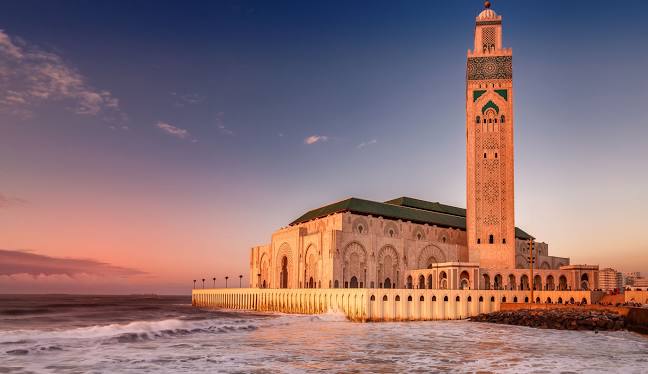
This blend gives Casablanca city a distinctive personality that is neither entirely old Morocco nor fully global city, but something in between, shaped by coastal light, sea air, and the practical needs of a modern commercial center. No description of Casablanca feels complete without mentioning the Hassan II Mosque, one of the city’s most iconic landmarks. Positioned beautifully by the ocean, it is notable not only for its size but also due to how it frames Casablanca’s relationship with the sea.
On certain days, the Atlantic wind adds a raw energy to the setting, and the sound of waves seems to underline the mosque’s presence. Even for people who are not focused on religious architecture, the location makes an impression, as the building feels like it belongs to the shoreline, anchoring identity in a space where land and water meet. Casablanca city’s cultural life is often discovered in everyday scenes rather than staged attractions. The city’s cafés are central to social life, serving as informal meeting rooms for friends, colleagues, and families.
People linger over coffee or mint tea, watch football matches, and debate politics or daily news. Markets and small shops remain essential, even as malls and modern retail expand. Casablanca city also has a growing creative energy, with galleries, music venues, and festivals that reflect a population comfortable navigating multiple influences, mainly Arab, Amazigh, African and European. Food in Casablanca mirrors its diversity and speed.
You can eat traditional dishes like tagine and couscous, but you’ll also find plenty of quick, urban favorites, such as sandwiches with grilled meats, seafood near the coast, and bakeries offering both Moroccan sweets and French-style pastries. Eating out can be a leisurely ritual or a practical necessity depending on the neighborhood and hour. In many places of Casablanca city, the smell of fresh bread and roasted coffee drifts into the street, mixing with the saltiness of nearby ocean air.
Casablanca city’s neighborhoods reveal different moods. Some areas feel polished and businesslike, while others are intensely residential and local, full of street vendors as well as small storefronts. Along the corniche and coastal promenades, the atmosphere can shift toward recreation, especially in the evenings when people come out to walk, socialize, and enjoy the sea breeze. Casablanca’s coastline is part of its charm, not only because it offers views and open space, but also because it gives the city a sense of horizon. In a dense urban environment, that openness matters.
Casablanca city is also a city of contradictions. It can be inspiring and exhausting, glamorous in one street and gritty in the next. Traffic can be challenging, and the sheer size of the population can feel overwhelming at first. Yet many visitors and residents grow attached to its authenticity. Casablanca rarely tries to perform a single identity. It simply is what it is. Ambitious, crowded, practical, and alive. It is a place where Morocco’s modern economy is most visible, where social change is often felt early, and in which the everyday life of millions unfolds in all its complexity.
To understand Casablanca city is to accept that it is not designed to be a postcard. Its beauty is often found in details, with the curve of an old façade catching late afternoon light, the rhythm of a tram passing through a busy intersection, the energy of a market street, or the ocean’s calm when the city finally quiets at night. Casablanca may not fit everyone’s expectations of Morocco, but it offers a compelling and honest portrait of the country’s present, as confident, evolving, and firmly connected to the wider world.
Another important part of Casablanca’s story is how quickly it continues to change. New infrastructure, expanding public transport, and redevelopment projects reshape the city’s daily routines and even its skyline, while long-established communities adapt to rising costs and shifting neighborhoods. This constant transformation can create tension between preserving familiar places and making room for growth, but it also gives Casablanca much of its character. The city feels like it is always in progress, always negotiating what it wants to become, and that sense of motion is often what people remember most, as a coastal metropolis where tradition and modernity don’t take turns, but coexist in real time.