Casablanca Morocco is the Kingdom’s largest city and its main Atlantic port, a place where the country’s past and future seem to meet at street corners. For many visitors, this destination is not only a storybook of winding medieval lanes and silent traditional houses. Instead, it feels modern, energetic, and unapologetically urban. With Flying To Morocco, that is precisely what makes it fascinating. Casablanca is where the Kingdom works, trades, studies, as well as invents itself every day, and spending time there reveals a side of the country that is just as authentic as its older imperial cities.
Casablanca Morocco
The identity of Casablanca Morocco is tied to ocean. The Atlantic shapes the city’s climate, its mood, and pace. Sea air drifts into neighborhoods throughout the day, and coastline offers long views that give a feeling of openness even when traffic is dense. Along the waterfront, you can sense how the port has influenced Casablanca’s history. Trade has always been a magnet here, drawing people from across Morocco and beyond. Over time, that movement created a city that is more mixed, outward-looking, and more experimental than many places in the region.
Casablanca Morocco is often described as the Kingdom’s economic capital, and while that can sound purely businesslike, it also means the city is constantly changing. New buildings rise, old cafés endure, and neighborhoods evolve in a way that reflects Morocco’s wider transformations. Architecture is one of the best ways to understand Casablanca. The city contains a striking blend of styles, shaped by different eras and ambitions.
In Casablanca Morocco, you can walk past early twentieth-century buildings with elegant facades, curved balconies, and geometric detailing, then turn onto a street lined with newer towers and practical apartment blocks. There is Art Deco influence in many central districts, and it gives parts of the city a distinctive look that feels both European and Moroccan, especially when paired with local materials and patterns. This architectural diversity is not just decorative, but tells a story of migration, colonial history, independence, and rapid growth.
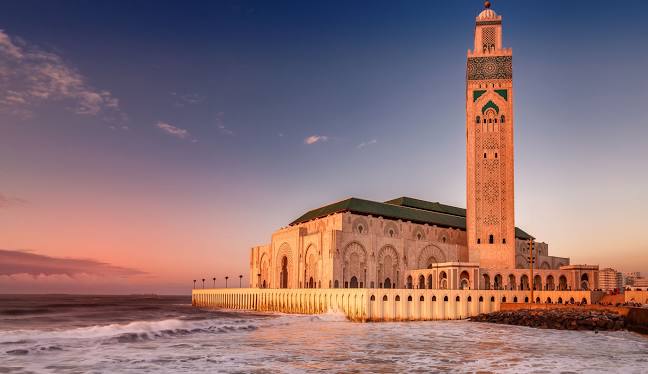
Casablanca Morocco expanded quickly, and that speed created contrasts, with spacious boulevards and crowded side streets, carefully planned zones as well as areas that grew in a more improvised way. The result is a city that rewards wandering, because each shift in scenery hints at a different chapter of its development. No description of Casablanca is complete without the Hassan II Mosque, one of the city’s most recognizable landmarks. Set beside the Atlantic, it seems designed to connect spirituality with the vastness of sea and sky.
Its scale is extraordinary, and the craftsmanship inside reflects Moroccan traditions of carving, tilework, and plaster detail. Even people who are not especially interested in religious architecture often find themselves moved by the balance of power and delicacy in the building’s design. The mosque also symbolizes the ambition of Casablanca Morocco, as it is a statement that the city is not only a center of commerce but also a place that can create monuments meant to endure.
Daily life in Casablanca Morocco can feel intense, especially compared with quieter Moroccan towns. Traffic is part of the experience, and so is the city’s constant hum, with taxis weaving through intersections, vendors calling out, café terraces full of conversation. Yet within this bustle, there are rhythms that make the city feel familiar after a short time. Cafés are central to Casablanca’s social life, serving as meeting points for friends, colleagues, and families.
In the morning, you’ll see people starting their day with coffee and something sweet, reading news or chatting before work. In the evening, the same spaces shift into places for long discussions, laughter, and observation of city life. Food in Casablanca Morocco is diverse and practical, shaped by the needs of a busy city. You can find classic Moroccan dishes like tagines and couscous, but you will also notice a broader mix than in many other places, including seafood influenced by the coast and international options that reflect the city’s cosmopolitan character.
Casablanca’s cultural personality is sometimes understated because it does not present itself as a tourist spectacle, but it has a creative pulse, visible in galleries, music scenes, and street art that appears on walls in unexpected places. The city also has an important role in Moroccan cinema and popular imagination, helped along by its global name recognition. Interestingly, the romantic aura that some people associate with Casablanca Morocco comes more from the famous film than the city itself.
The real Casablanca Morocco is less nostalgic glamour and more about contemporary life, ambition, and complexity. That contrast can be part of the city’s charm. It refuses to be reduced to a single image. What makes Casablanca worth writing about, and visiting, is how it reveals modern Morocco in motion. It is a city of opportunity and challenge, where people arrive looking for work, education, or a new start. It is also a city where traditional values and modern aspirations coexist, sometimes smoothly and others with tension.
You can see this in fashion, language, and everyday choices, from the mix of classic Moroccan clothing and global streetwear to the way people switch between Arabic, French, and other languages in the same conversation. Casablanca Morocco does not ask to be idealized, but understood on its own terms. It offers a portrait of Morocco that is dynamic, layered, and real. It is not merely a gateway to other destinations, though many travelers pass through it, but a destination in its own right, full of stories embedded in its buildings, seaside air, cafés, and crowds.
The city’s energy can be demanding, but it also feels honest. Casablanca Morocco is the Kingdom looking outward across the Atlantic and inward at its own evolution, a place where the future is being negotiated in the ordinary moments of everyday life. For a quieter escape within the city, parks as well as seaside promenades give residents space to breathe between the rush of work and traffic. Also, if you pay attention, you’ll notice a resilient warmth in how people navigate the city’s speed, turning ordinary errands into moments of humor and connection.